
GB1-Story

GB1-Story

If you’re looking to purchase a new baby grand piano, the choices out there are vast and varied. Some brands are familiar and some are pretty obscure – but they all claim to be the best in their relative price points.  It’s impossible for me to make a blanket statement about which brand or model may be best for you because we’re dealing with two things – Facts and Emotion. Facts are universal (objective).  They can be tested and proven. Emotions are just as real, but they aren’t universal (Emotions are subjective).  So – since we can’t comment on an individual’s feelings – let’s take emotion out of the equation for a moment and focus on the facts surrounding Yamaha‘s most popular baby grand piano:  the Yamaha GB1K.


Let’s start with this factual statement: Yamaha is globally recognized for making superior musical instruments in a large variety of categories.
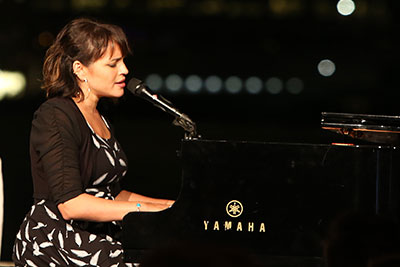
Yamaha has the world’s largest artist roster – with over 3600 members, including Norah Jones.

Yes.  There are other great brands, but none more recognizable or universally respected than Yamaha. Around the world, more performers require a Yamaha piano than any other brand because they know that Yamaha can deliver the sound and touch they are looking for. With over 10,000 musical instrument patents (more than 2000 related to pianos alone), Yamaha has done more than any other manufacturer to further the develop and refine the music industry.  Each instrument in their lineup is specifically designed and meticulously crafted to deliver a specific performance profile to the musicians most likely to use it.  At times, this might seem confusing as Yamaha will use different designs and materials for different models simply to create the specific sound and touch they are looking for.  Thus, Yamaha instruments require broad consideration when compared with other brands.  You can’t just pick out a component or two.  You have to compare the overall intent of the instrument and it’s ability to deliver that intent to a potential buyer.  …and this brings us to the Truth about the Yamaha GB1K Baby Grand Piano:

It’s the best designed, best engineered, and best built five foot baby grand piano on the market.

Clearly, that’s an opinion, but let’s look at the facts I use to reach that conclusion…

Yamaha has maintained a state-of-the-art piano factory near Jakarta, Indonesia, for over 40 years.  The machinery, designs and training for this plant all come from Japan.

Yamaha’s 40-year old piano factory in Indonesia (located just outside of Jakarta) is state-of-the-art. They use the same machines as the factory in Japan and cross-train their workers to maintain the highest level of quality. Remember, it’s the company of origin and not the country of origin that makes the most difference.  Yamaha makes the soundboards for all of their pianos (including the GB1K) in Japan and then ships the GB1K soundboards to Indonesia to be installed with the rest of the components made in their Indonesian plants.  Think about that for just a moment.  Yamaha’s construction process is so precise that wooden components can be made in one factory and installed in another without modification.  Because Yamaha is 100% vertically integrated (meaning they own and control everything from the forest to the factory), they can take advantage of local woods and labor in Indonesia without compromising the quality or performance of their pianos.  This is one way Yamaha can make a superior baby grand piano at a very competitive price.

In order to achieve it’s designated sound profile, the Yamaha GB1K uses very specific, high-quality woods.  Again, because they have a plant in Indonesia, Yamaha has access to many great woods at a much lower cost.  In fact, as of March, 2022, Yamaha has switched the wood they use to make the GB1K’s rim.  Both the new rim and the old rim are made from high quality hardwoods (part of Yamaha’s formula to produce a specific sound in their five foot baby grand piano), but the nyatoh wood Yamaha used to use isn’t as available in the quantity or quality Yamaha needs so they have begun using sapele (a wood often found in acoustic guitars) in its place.  The sapele woods have a darker, richer look, but produce the same sound Yamaha wants for its GB1K.
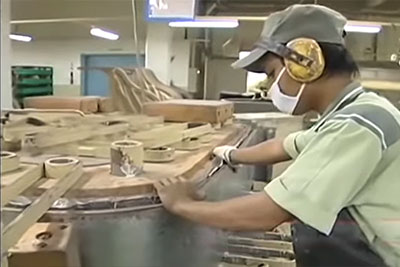
Here workers from Yamaha Indonesia build a grand piano rim – exactly to Yamaha’s global specifications.

Other manufacturers like to criticize Yamaha’s decision to use nyatoh or sapele rims when other manufacturers have chosen maple.  They might criticize the GB1K’s rim thickness or music rest… but doing so misses the larger point:  Yamaha made the GB1K this way on purpose.  Unlike other manufacturers who simply design one large piano and then use the same features (with different scale designs) on all the smaller models, Yamaha takes the time and care to build a specific tonal recipe for every model.  Every aspect of the piano was specifically designed to work in harmony to make this smaller grand perform like a much larger and more expensive instrument. For example, the sapele rims give a warmth and richness to Yamaha’s GB1K.  With a maple rim, the piano would be louder and brighter – something  today’s baby grand buyers won’t appreciate.  The rim thickness is perfect for this piano as well.  It provides the sound transfer, power and stability that Yamaha is known for around the world – without requiring overly thick and rigid rims.  The GB1K is perfectly designed for its character and purpose – whether playing classical music or jazz.  It gives you the control to make any kind of music really shine!

Yamaha designed this piano to have the richness of a piano that is six or eight inches longer. The bass is full and resonant with clarity (even in the extreme lower register!) while the mid-range has a beautiful singing quality. The upper register is bright with a wonderful sustain, but not choppy or harsh. Overall, it’s a clear and balanced sound that allows for unlimited expression.
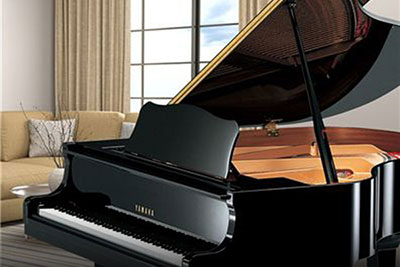
Made to fit a certain sound and customer profile, the purpose-built Yamaha GB1K is a magnificent baby grand piano.

In the many years I’ve been selling Yamaha pianos I’ve seen people shop around for less expensive pianos but end up spending more for a Yamaha because, quite simply, they are worth it. Yes, the GB1K costs more than some other brands and may have a feature or two that someone else can argue about, but the fact is:  Yamaha purpose built this piano to sound and feel exactly the way it does… and – considering it’s one of the most successful selling baby grand pianos we’ve ever seen – I’d say they did a pretty good job!

As for you, for something you are going to have as long as a piano – I always say it’s better to spend more than you wanted than less than you should. Reward yourself. You never regret getting the best.  Check out the Yamaha GB1K online or – better yet – stop in and see one for yourself.  There’s nothing like the real, in-person Yamaha Experience.  See you soon!

CX Series Features

CX Series Features

Yamaha CX Series Features

Seasoned for Destination

All Yamaha pianos destined for the United States market are seasoned for the U.S. climate.

Additional Information

Starting with dimensional lumber, Yamaha is in complete control of wood processing. Yamaha utilizes outside seasoning yards, computer-controlled kilns and air conditioned factories to ensure that the final product will withstand the climactic conditions experienced during the piano’s lifetime.

This provides peace of mind knowing that the piano was made specifically for use in the United States, thus eliminating the problems found in pianos not seasoned for this climate.

V-Pro (Vacuum Shield Mold Process) Plate

The cast iron plate (harp) is the foundation of a quality acoustic piano

Additional Information

Traditionally, piano plates have been cast by a process that uses wet sand. An impression made in the wet sand by a pattern, leaves a cavity that is filled with molten iron to form the plate. Certain problems inherent with this method are: a) the exactness of measurements and contours of the cavity are compromised by 
the crudeness of the grainy, wet sand AND uneven cooling caused by the extreme temperature differences between the molten metal and the wet sand, create structural weakness. Yamaha eliminated these problems by developing the Vacuum Shield Mold Process (V-­Pro). With V­-Pro, Yamaha can cast plates that are stronger. The V-­Pro plate is visually more appealing. The V-­Pro process ensures that the iron frame is stronger and will thus further 
improve tuning stability. It allows dimensions and shapes to be produced more accurately than ever before.

X Series Soundboard Crown Design

Special Soundboard Crown Design Improvements

Additional Information

Yamaha has perfected a new system for creating soundboard crown in all X Series pianos, beginning with the C3X. This design was developed for use with CFX, Yamaha’s flagship concert grand. Manufacturing expertise made it possible to incorporate this design in X Series pianos C3X and larger.

German Piano Wire

Highest quality German piano wire

Additional Information

X- Series Grands are made with the finest materials available. German piano wire is considered the finest wire available. This wire is considered the most dimensionally consistent wire used in the highest quality pianos.

Ivorite – White Key Surfaces

That classic touch

Additional Information

After more than 20 years of laboratory research, Yamaha developed a new white key covering called Ivorite. Ivorite has the same performance characteristics as real ivory, such as moisture absorption, non-­slip resistance and hardness. In addition, it offers greater durability over the years. Ivorite ­covered keys visually present the traditional image and touch of real ivory. Owning a piano with Ivorite keys provides enjoyment, prestige and image.

WPC – Black Key Surfaces

That classic touch

Additional Information

After many years of laboratory research, Yamaha developed a new black key covering called Wood Process Composite (WPC). WPC has the same performance characteristics as ebony, such as moisture absorption, non-­slip resistance and hardness. In addition, it offers greater durability over the years. WPC ­covered keys visually present the traditional image and touch of ebony.

German Hammer Felt

German Hammer Felt for the absolute best tone quality.

Additional Information

German Hammer Felt produces an incredible tone. This felt is very consistent and is easy for the piano technician to voice, providing a very even sound, from note to note, and at the various volume levels.

Extruded Aluminum Alloy Action Rails

Extruded Aluminum Alloy Action Rails

Additional Information

Yamaha engineering developed a unique extruded aluminum alloy action rail (bearing a Yamaha patent) that is one of the greatest innovations in the last 100 years for improving a piano action. All Yamaha extruded aluminum alloy action rails are impervious to weather changes and solve the problems caused by wood rails. The usual fluctuations in wood rails that affect touch, caused by periodic weather changes, are eliminated. Screws remain tight, which maintains better alignment of all action parts and allows stable, long-lasting action regulation. The extruded aluminum alloy action rails endure during the life of the piano.

Soft-Close Fallboard

This eliminates the possibility of the fallboard slamming down and causing physical harm or damage to the piano.

Additional Information

Realizing the problems created by the conventional fallboard system, the engineers at Yamaha eliminated the pivot pins at each end of the fallboard and replaced them with the Soft-Close fixtures. Each of the fixtures contain a hydraulic device that is activated as the cover is closed. This counter-balances the weight of the fallboard and allows the cover to float down rather than fall down. Peace of mind knowing that the possibility of physical harm from the fallboard closing, along with possible damage to the piano, has been eliminated.

Improved From C Series:

  • X Series Scale Design
  • X Series Soundboard Crown Design
  • German Piano Wire
  • German Hammer Felt

Premium Yamaha Pianos

Premium Yamaha Pianos

Yamaha SX Series – The New Contender in Premium Pianos

Yamaha has always been known for high quality mass-produced pianos. Indeed, their Conservatory Series (or CX-Series) pianos are the most sought-after pianos for recording studios, universities, schools and churches the world over! Solidly built and consistently reliable, the Conservatory Series grand pianos have long been the “go-to” pianos for many decades.
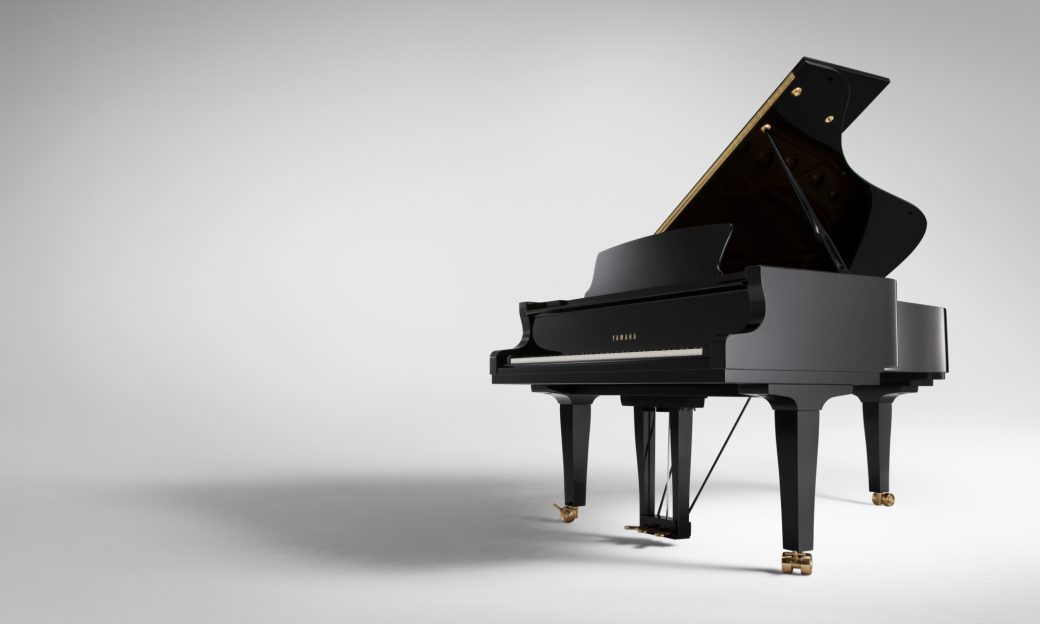
However, in recent years, Yamaha has put a greater emphasis on building highly expressive and nuanced premium pianos that offer a performance level previously only found in the venerable handcrafted brands of Europe.  Created

with time-honored methods passed down from generations of master builders, these stunning instruments are often chosen over the CX-Series for their more refined tone, even projection, longer sustain and rugged craftsmanship. The Yamaha SX-Series Pianos are selected by universities, music conservatories, K-12 schools, churches, and discerning retail customers who simply refuse to compromise on quality and tone.  As a result, Yamaha has developed a new series of pianos for clients with a discriminating sense of tone and touch – developed to stand “toe to toe” with the iconic European brands – but at a far more accessible price.  This is the Yamaha SX-Series of premium grand pianos.


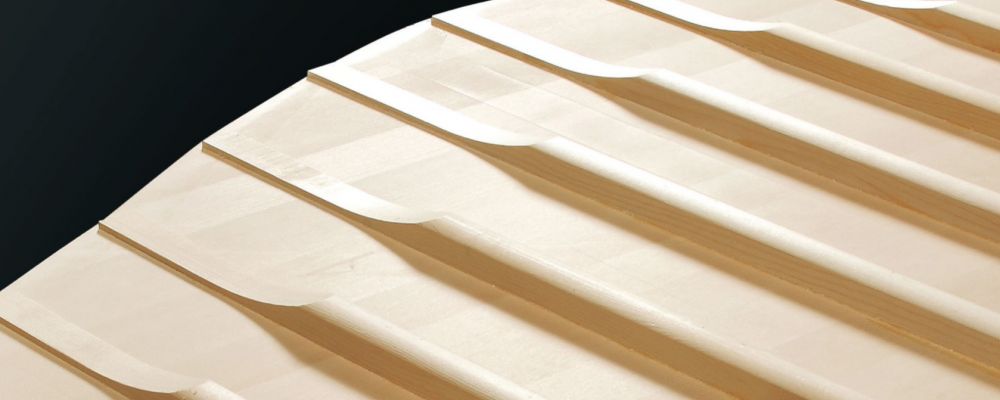
The European Spruce used in Yamaha piano soundboards is twice as expensive as the Alaskan Spruce used in Steinway pianos. It is one of the most expensive components in the piano.

Yamaha’s SX-Series and flagship CF-Series pianos are both made in their Kakegawa workshop – the most advanced piano manufacturing facility of its kind. The CF-Series pianos are entirely handcrafted by Yamaha’s most skilled and experienced artisans – many second or third generation piano builders.  This is also the birthplace of the iconic Yamaha CFX Concert Grand Piano – one of the most in-demand performance pianos around the world. The SX-Series is built in the same building – using the same old-grown European spruce, rock maple and mahogany woods found in the CF-Series pianos.  Chosen for their tonal quality and seasoned to perfection, these woods represent the heart of the piano’s voice and the character that makes Yamaha SX-Series pianos unique in all the world.  Next, Yamaha employs a proprietary (patented) technology called Acoustic Resonance Enhancement (A.R.E.) that uses moisture control, temperature manipulation and pressure to enhance the wood’s natural tonal characteristics.  The resulting sound carries the warmth and depth that was previously only found in vintage pianos from 100 years ago.  All of this is done without chemicals and without damaging the wood’s longevity.  It’s a true breakthrough in piano manufacturing.


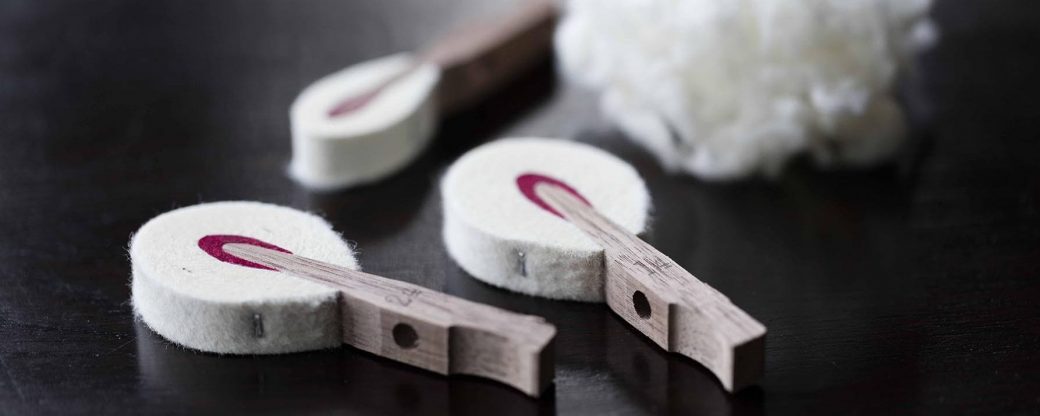
Yamaha spent years developing hammers for their SX-Series pianos using feedback from concert pianists around the world. SX-Series hammers provide incredible versatility and tonal control.
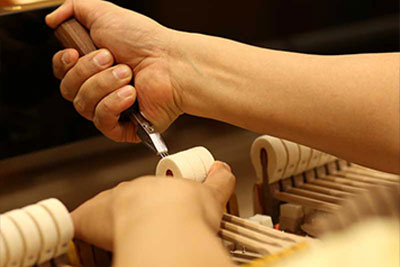


This seasoned, enhanced wood is now formed into a thicker, more resonant frame and a custom diaphragmatic-tapered soundboard with European Spruce ribs.  This combination of stronger foundation and more delicate soundboard give the piano incredible majesty at fortissimo volumes without sacrificing the light, airy treble tones that dance in the air when playing the piano quietly.  Finally, Yamaha tested over 100 different hammer felt recipes to find the absolute perfect tone for each model of the SX-Series – giving each SX-Series piano it’s own unique voice.  This paired with their hand-wound bass strings make each piano special without sacrificing consistency or quality control.  The result is a truly personal playing experience that transcends the world-class components components and time-honored manufacturing techniques Yamaha uses to create these magnificent instruments.

Next, each SX-Series Yamaha piano goes through a rigorous voicing and regulation process by Yamaha’s most talented and experienced piano technicians. Acute attention is spent on bringing the individual character and voice out of each piano before it leaves the factory.

Made with the reliability and stability of Yamaha’s legendary CX-Series pianos, the SX-Series offers premium quality and performance at a price that most fully handcrafted pianos can’t achieve.  As a result, countless institutions, concert pianists, professors and piano aficionados have selected Yamaha SX-Series Pianos and raved about their performance.

History of Yamaha Pianos

History of Yamaha Pianos

You can hear the distinctive sound of Yamaha pianos in concert halls, recording and rehearsal studios, places of worship, and educational institutions through out the land.

Here’s a brief history of the more than a hundred years that shows how one man’s dream to craft the world’s finest concert grand pianos became a reality, thanks to the efforts of a century’s worth of skilled craftsmen and musicians.

1900 – 1949

The first piano to be made in Japan was an upright built in 1900 by Torakusu Yamaha, founder of Nippon Gakki Co., Ltd. — later renamed Yamaha Corporation. Just two years later, the Nippon Gakki factory resonated with the tones of its first grand piano. During this early period, the company focused on manufacturing instruments for the Japanese market, where interest in Western classical music was still relatively new. Even so, Torakusu did send one of his pianos to the 1904 St. Louis World’s Fair, where it received an Honorary Grand Prize.

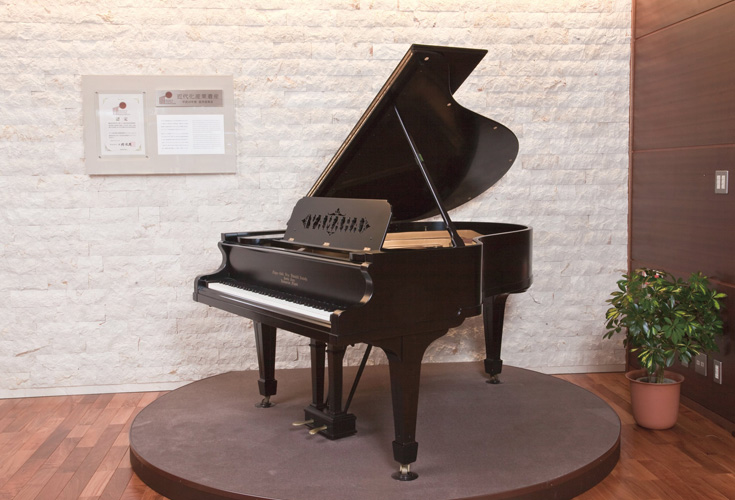
Yamaha grand piano c. 1902

By the 1920s, Yamaha craftsmen were regularly traveling overseas to gain knowledge of the latest European piano production techniques. In 1926, the company invited Ale Schlegel, an expert piano technician from Germany, to visit with the craftsmen at the Nippon Gakki facilities in Hamamatsu, Japan and discuss piano making in exhaustive detail. Schlegel’s advice yielded a much improved product. Before long, well-known European pianists were taking favorable note of Yamaha instruments, among them Arthur Rubinstein and Leo Sirota.

1950 – 1959

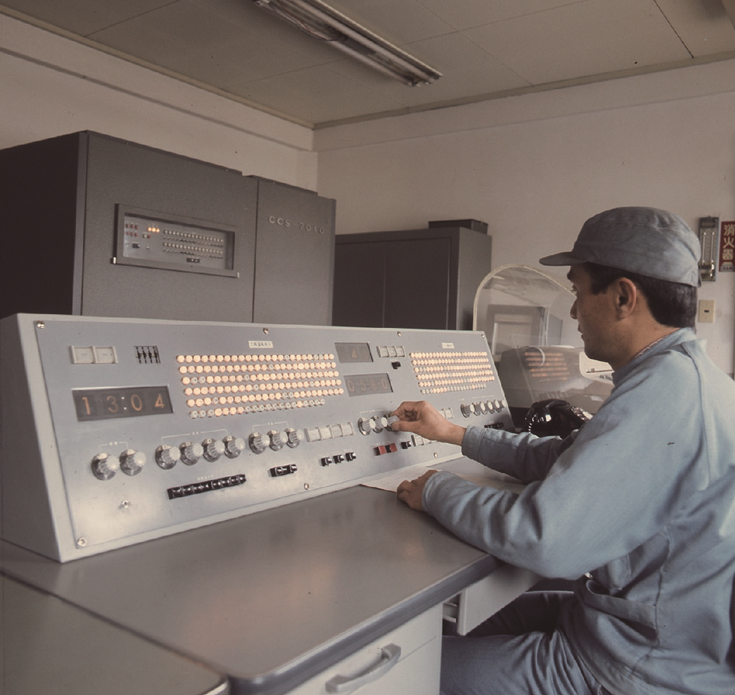
In 1950, Yamaha released the FC concert grand piano to great acclaim. Spurred on by that model’s success, the company built one new facility after another in its continuing quest to make an even better piano. In 1956, the company completed work on Japan’s first computer-controlled artificial drying room, where the moisture content of wood — a vital factor for any piano — is adjusted to the optimum level after the natural drying process is complete. In 1958, Yamaha set up a grand piano assembly line at its Hamamatsu headquarters.

Computer-controlled wood drying in the Yamaha factory.

1960 – 1969

At the start of the 1960s, Yamaha made a major move, creating a new company in the U.S.A. to import and distribute its pianos: Yamaha International Corporation. By 1965, Yamaha was producing more pianos than any other manufacturer.

In that same year, Cesare Tallone, one of Europe’s most respected piano technicians, came to Japan and visited the Yamaha factory. Deeply impressed by its facilities and employees, he elected to work with the company on the development of a new world-class concert grand. Over the next two years, Yamaha craftsmen-built prototypes that were evaluated by several highly regarded pianists; their feedback was then incorporated into further new designs. Finally, in November 1967, the CF concert grand piano was unveiled during a banquet at Tokyo’s Hotel Okura. Playing the piano on that occasion was Wilhelm Kempff, who went on to call it “one of the top pianos in the world.”

The CF, along with the simultaneously introduced C3 grand piano, took the world by storm — with a little help from an all-time great. Sviatoslav Richter’s first encounter with a CF occurred at a January 1969 concert in Padua, Italy. The Russian maestro chose to play one again later that year at the Menton Music Festival in France, after testing several pianos from different manufacturers during rehearsal. Richter played (and praised) Yamaha pianos from that point forward, marking the beginning of a relationship with the company that would last for the rest of his life.

1970 – 1979

During Sviatoslav Richter’s first Japanese tour in 1970, he performed at the Osaka World’s Fair on a CF bearing the serial number 1000000 — the one-millionth piano manufactured by Yamaha. One by one, European music festivals adopted the CF as their official piano, including the Antibes, Saint Tropez and Menton Festivals in France. Samson Francois, Tamás Vásáry, Byron Janis, Lívia Rév, Alexis Weissenberg and Georges Cziffra were among the many pianists who favored the CF, as its fame around the world continued to spread.

1980 – 1989

Another legendary pianist was drawn to Yamaha in 1980. Glenn Gould purchased two CFs that year and used them on the final three albums he made before his tragically early death in 1982 at the age of 50, including his second reading of J.S. Bach’s Goldberg Variations, now regarded as an all-time classic.

With new concert halls springing up all over Japan at that time, Yamaha craftsmen were inspired to develop a concert grand piano for a new generation. Building on the CF’s successes, they again went to work developing a series of prototypes, each of which was evaluated by top pianists. Krystian Zimerman was so pleased with his that he took it with him on a European tour. After further improvements, Yamaha craftsmen unveiled the CFIII in 1983. It was an instant hit, designated as the official piano of East Germany’s International Johann Sebastian Bach Competition, Poland’s International Chopin Piano Competition and the Soviet Union’s International Tchaikovsky Competition.

Yamaha also created a new kind of piano in the 1980s with the Disklavier, which made its American debut in 1987 (an earlier model called Piano Player was introduced in Japan in 1982). Originally designed as an acoustic piano outfitted with electronic controls for recording and playback, it has been updated and refined as technology has evolved in the decades since.

1990 – 1999

In 1991, Yamaha reached the impressive manufacturing milestone of five million pianos. The company also introduced the successor to its CF and CFIII concert grand pianos: the CFIIIS, which underwent two further upgrades in 1996 and 2000. At the Moscow Conservatory in July 1998, a young Russian pianist named Denis Matsuev took the International Tchaikovsky Piano Competition’s top prize performing on a CFIIIS.

2000 – 2009

The Japanese music world celebrated in 2002 when Ayako Uehara won the 12th International Tchaikovsky Competition. She was both the first Japanese winner and the first female winner in the contest’s history — and she did it on a Yamaha CFIIIS. A decade that marked the 100th anniversary of Yamaha’s piano production also saw the CFIIIS become the official piano of more than 20 major international competitions.

2010 – Present

After 19 years of research and development, the Yamaha CF Series concert grand piano, successor to the CFIII, made its debut in May 2010. Later that year, the winners of both the National (U.S.) and International Chopin Piano Competitions made history playing a CFX piano. In 2016, Yamaha celebrated the Disklavier’s 30th anniversary by releasing its seventh iteration, the ENSPIRE. That same year, Yamaha received a prestigious “Top 100 Global Innovator” award from Thomson Reuters for the third consecutive year. 2017 saw the launch of the SX Series, a premium grand piano line that incorporates A.R.E., the wood-reforming process used in top product lines of other Yamaha divisions.

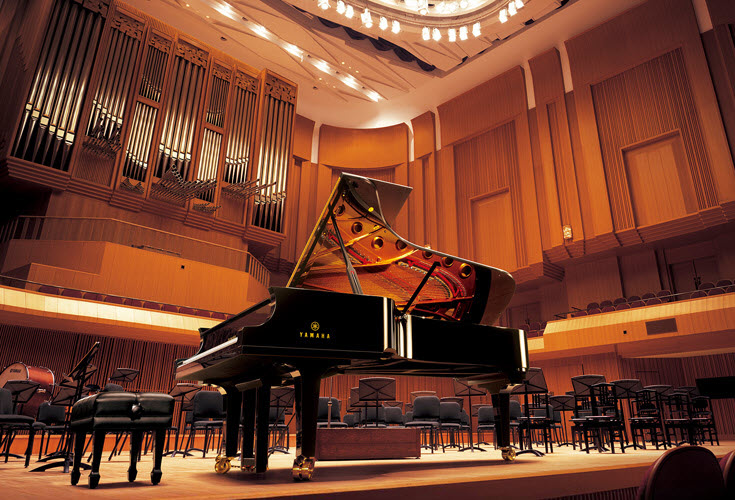
Yamaha CFX grand piano.

What will come next? If the past hundred-plus years are anything to go by, you can be certain that Yamaha will continue to make pianos of the highest quality for a long time to come.